Wrapped in Red: A Creative Reflection on MMIWG
Written and filmed by Natasha Ferguson
Course: Indigenous Ways of Knowing
“Wrapped in Red” is a creative video project exploring Missing and Murdered Indigenous Women and Girls (MMIWG) through the lens of human rights and social justice. It represents an opportunity to bring together my academic learning, creative expression, and reflection on my Métis heritage.
Through this project, I wanted to engage with an issue whose significance extends beyond the classroom. Creating a video offered a different way to communicate my learning—one that invited viewers to pause, reflect, and consider the people and families at the heart of the issue.
The Purpose of the Project
My purpose was to create a thoughtful response to MMIWG that emphasized dignity, remembrance, and the responsibility to pay attention. I wanted the project to encourage reflection on how Indigenous women and girls are represented and how their lives, relationships, and identities can be acknowledged with care.
The project also gave me an opportunity to consider how creative work can communicate human rights concerns. Academic writing allows for detailed analysis, while video offers possibilities through imagery, pacing, sound, and silence. Working in this format encouraged me to think carefully about how a message is experienced as well as what it says.
My Creative Approach
Writing and filming the video required me to make deliberate choices about how to present a sensitive subject. I considered what I wanted viewers to understand, which ideas needed emphasis, and how to communicate respectfully.
The title, “Wrapped in Red,” gave the project a clear identity and a starting point for reflection. In presenting the video here, I also want to explain the choices behind it: why I selected particular images, words, or sounds, and how those elements supported the project’s purpose.
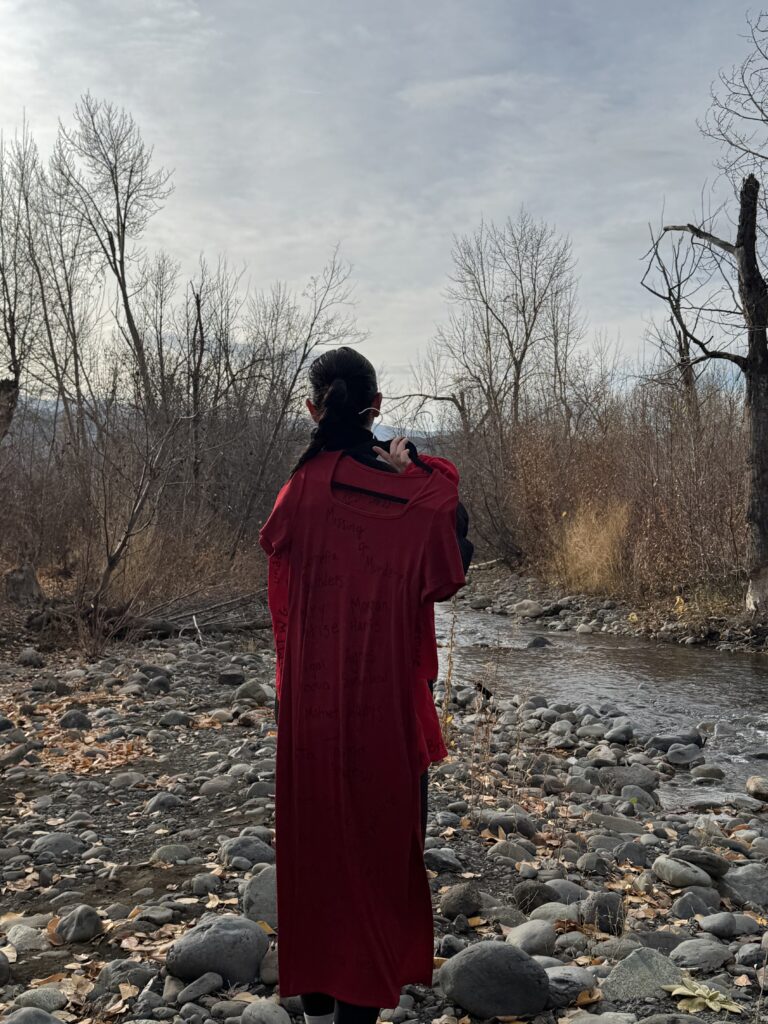
I used the Red Dress in honour of the Red Dress Project and used names off their website to show these women’s real names and have people aware these are real people. I shot the video on traditional land and used nature as the background for this video in respect to our unceded territory.
This process helped me recognize that creative expression carries responsibilities. A powerful image or emotional response needs to be accompanied by care in how people and experiences are represented. I wanted my contribution to reflect my own learning while recognizing the importance of the voices of families, survivors, and Indigenous communities.
Connecting the Project to My Métis Heritage
As a Métis student, this project provided an opportunity to reflect on the relationship between my identity and my studies. It encouraged me to consider how learning about Indigenous human rights can be both an academic responsibility and a personally meaningful process.
My heritage informs the questions I bring to this work, while also reminding me to continue learning. Indigenous peoples have distinct histories, cultures, and experiences, and my perspective cannot represent them all. This project encouraged me to approach those differences with respect and to remain attentive to whose perspectives are being shared.
It also strengthened my interest in Indigenous education. I became more conscious of the responsibility involved in teaching and communicating about difficult subjects: providing context, avoiding generalizations, and creating opportunities for meaningful reflection.
What I Learned
One of my most important takeaways was that research and creative expression can work together. Developing the video required me to translate my learning into a form that could reach an audience beyond an academic paper. This strengthened my ability to communicate with purpose and encouraged me to think about how public understanding is shaped.
The project also prompted reflection on the relationship between awareness and responsibility. Bringing attention to an issue is a starting point. I wanted viewers to consider what respectful engagement might involve, including listening, continuing to learn, and examining the institutions and assumptions that shape whose concerns receive attention.
Creating “Wrapped in Red” broadened my understanding of what scholarship can look like. It showed me that a creative assignment can involve careful inquiry, ethical judgment, and a clear connection to human rights principles.
Why I Am Sharing It
I am including “Wrapped in Red” in my e-portfolio because it represents a meaningful part of my development during the MA. Alongside my research papers and presentations, it demonstrates my interest in communicating human rights and social justice through different forms.
The project brings together my background as an educator, my developing academic perspective, and my reflection on Métis identity. Sharing it allows me to document both the work itself and the learning behind it—particularly the importance of dignity, thoughtful representation, and continued engagement with Indigenous human rights.
Watch “Wrapped in Red”
Watch my creative video project, “Wrapped in Red,” on YouTube.