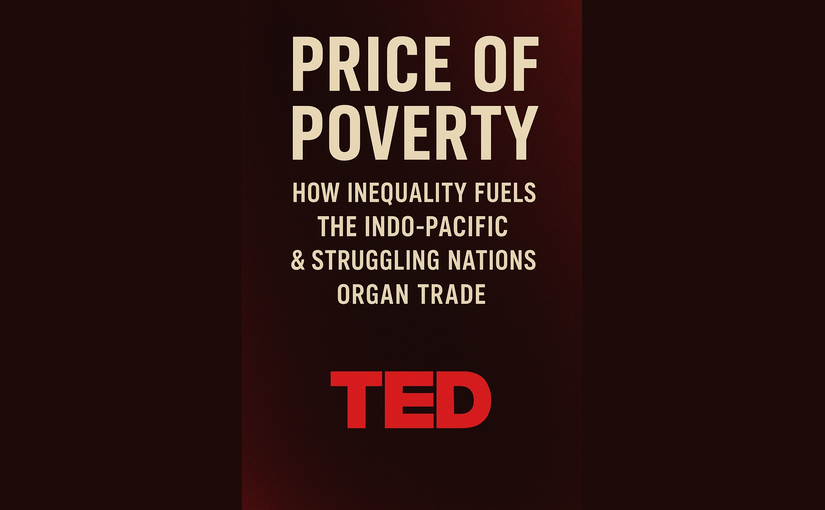
The Presentation That Sparked My Research Direction
Course: HRSJ 5010 — Foundations of Human Rights and Social Justice
Assignment: TED-style presentation on organ trafficking
Presentation: Watch my presentation
One of the most meaningful assignments I completed during my Master of Arts in Human Rights and Social Justice was a TED-style presentation on organ trafficking for Foundations of Human Rights and Social Justice. This assignment sparked an interest that has since become a central focus of my graduate research.
My approach was to examine organ trafficking through a human rights and social justice lens, exploring how poverty, inequality, and financial desperation can create conditions for exploitation. My argument emphasized the importance of looking beyond individual transactions to consider the social, economic, and institutional conditions that shape people’s choices. This approach encouraged me to ask how meaningful consent can be understood when someone’s options are severely constrained by poverty.
Preparing the presentation challenged me to communicate a complex subject clearly and accessibly. I had to organize my research into a focused argument and explain its significance to an audience that might be unfamiliar with the issue. The process helped me connect foundational concepts of human dignity, rights, and justice with a concrete example of exploitation.
The assignment was particularly impactful because it gave my academic interests a clearer direction. What began as a course presentation developed into a sustained interest in bodily autonomy, coercion, and the commodification of human life. These questions informed my subsequent research on organ trafficking and transplant tourism, including my examination of whether exploitative transplant tourism can be understood as a form of modern slavery.
Looking back, I see this presentation as an important starting point in my development as a researcher. It demonstrated how a classroom assignment could lead to deeper inquiry across multiple courses and strengthened my commitment to exploring the relationship between human rights, social inequality, and healthcare.
| Course | Title shown on transcript |
|---|---|
| HRSJ 5010 | Fdns of HRSJ |
| HRSJ 5020 | Indig Ways: Ped. and Practices |
| HRSJ 5250 | Risk, Place and Social Justice |
| HRSJ 5030 | Problem Solving in the Field |
| HRSJ 5220 | Trauma, Rights and Justice |
| HRSJ 5270 | Social Det. and Medicare |
| HRSJ 5040 | HRSJ Field Experience |
| HRSJ 5940 | Master of Arts e-Portfolio |
| HRSJ 5230 | States, Violence, Revolutions and the Emergence of Global Capitalism |
| HRSJ 5710 | Critical Race Studies and Racial Justice |
Reading Reflection: “Of Monsters and Men”
Course: HRSJ 5220 — Trauma, Rights and Justice
Reading: “Of Monsters and Men”
Citation: Mohamed, Saira. “Of Monsters and Men: Perpetrator Trauma and Mass Atrocity.” Columbia Law Review, vol. 115, no. 5, 2015, pp. 1157–1216.
One of the most impactful readings I encountered during the MA was “Of Monsters and Men,” which I read and presented in Trauma, Rights and Justice. What stood out to me was its invitation to consider perpetrator trauma—a dimension of harm that I had not previously given much attention to.
Before engaging with this reading, my thinking about trauma centred primarily on people who had experienced violence or exploitation. Considering trauma among those who perpetrate harm challenged that perspective. It introduced another side of the issue and encouraged me to ask questions I would not normally have considered.
This was an uncomfortable but meaningful shift. I had to think about how acknowledging a perpetrator’s trauma could coexist with accountability and concern for those they harmed. I came to understand that examining someone’s experiences does not require excusing their actions. It can deepen our understanding of harm while preserving the responsibility to address it.
Presenting the reading gave me an opportunity to work through this tension and articulate why it mattered. Explaining an idea that challenged my own assumptions required me to pause, reconsider my initial reactions, and remain open to a more complex interpretation.
The reading was impactful because it reminded me that critical thinking sometimes means engaging with perspectives that are difficult to accept. It encouraged me to resist reducing people to a single category and to examine the relationship between trauma, responsibility, and justice more carefully.
I will carry this lesson into my future research and professional work. Understanding human rights and social justice requires attention to difficult questions, including those that unsettle familiar distinctions. “Of Monsters and Men” helped me become more willing to explore those questions without losing sight of dignity, accountability, or the experiences of people who have been harmed.